Architect, illustrator and author, in 2010 Matteo Pericoli started his Literary Architecture Workshop, which invites participants to transform short stories and novels into architecture. It is not a matter of imagining or giving shape to the locations and environments that the writing narrates, but rather of understanding the very structure of the story and translating it into a building. A meta-literary exercise in which the author’s narrative construction acquires, in the hands of the reader, concreteness in the form of drawings or models. The book itself, which contains twelve examples referring to as many novels, such as Heart of Darkness (Conrad), The Adversary (Carrère) or The Years of Annie Enraux, developed by Pericoli himself, is presented as an architectural structure, specifically a museum in the Greek sense of the term as a place sacred to the Muses, ideal for inspiration and contemplation. The buildings that arise from the Laboratory are by necessity subjective. For example, in front of Amy Hempel’s short story The Harvest, which twice recounts a car accident in which the writer herself is a victim – though the second story begins with the unsettling words “I omit many things when I tell the truth” – two groups participating in the workshop imagine different buildings, though both as deceptive-looking as the story, with unexpected spaces, columns that do not hold anything up and furniture elements – made of concrete – that are instead the real structures of the building. Surprising in many ways, Il grande museo vivente dell’immaginazione makes you want to try it yourself, with a beloved short story, drawing paper, colored pencils, cardboard, glue and scissors.
Il grande museo vivente dell’immaginazione Matteo Pericoli Il Saggiatore, Milan, 2022 166 pages, 25 euros ISBN 978-88-428-3218-8
“What if these kinds of spaces, which we will call ‘literary architecture’, were narrative structures turned into actual architectural structures? Why not take the architecture of a story and turn it into a building?” (M. Pericoli, Il grande museo vivente dell’immaginazione. Guida all’esplorazione dell’architettura letteraria, Milano, Il Saggiatore, 2022, p. 16)
On the threshold
Upon entering the Great Living Museum of the Imagination, we feel the distinct impression that someone is taking us by the hand and leading us along a path with a sure hand, yet able – at the same time – to respect our time (our pace), to let us move freely without, however, ever losing sight of us. The voice that guides us is that of Matteo Pericoli, an architect, illustrator and author who succeeds, in this book-museum, in cultivating a fertile middle ground, that of Literary Architecture, a dimension that cannot be ascribed to a new form of architecture or literature. The book, in fact, has sprouted from the more than decade-long experience of The Laboratory of Literary Architecture (lablitarch.com), an experience of true unearthing of a still unexplored territory. Upon scrolling down the first page we feel a tear, we immediately become readers who, while reading, become visitors to a space, immersed in a construction “that has its own functioning and structure.” Play within play, Matteo Pericoli thus leads us to live a twofold experience: that of readers/visitors exploring a space that houses Literary Architecture and, simultaneously, that of those who can experience firsthand what happens when – thanks to words (written, but, above all, read) – an architectural structure inspired by a novel or a story takes shape.
The Tool Bag
Upon entering the book-building, we can explore the environments that make up an itinerary that gradually introduces the reader/visitor to Literary Architecture. A succession of spaces unravels between the entrance to the Museum and the exit, leading the reader through progressively illuminated and illuminating environments: if in the first section of the text (Ground Floor and First Floor) the author presents the theoretical-structural elements of Literary Architecture, in the second section (Second Floor), on the other hand, a wide selection of literary architectures inspired by well-known or lesser-known novels finds its place (each architecture is accompanied by a short text introducing both the novel in question and the particular interpretative insight that gave rise to that very architecture). We are dealing, then, with a book that provides both the tool bag to use and, later, some examples that the reader can read/watch to approach the middle ground of literary architecture.
The theoretical dimension of the experiment is presented by drawing on the previous (and current) experience of the reader who is constantly urged to question the act of reading, its potential, and what can happen to anyone who reads a short story or a novel not only by visualizing what he or she reads, but by sensing that he or she is situated in a (literary) space that can be translated into formal structures precisely because it itself consists of architectural elements; in fact, Matteo Pericoli argues that literary architecture arises when disciplinary boundaries blur and one begins to perceive architecture as a spatial narrative and, simultaneously, the literary text as the construction of a space:
[…] these thoughts occur when we least expect it and above all when we allow our mind to move freely and silently, without taking anything for granted, without prejudices or any particular goal, and, above all, without fragmentation […] (p.27)
The fragmentation to which the author refers concerns both the jealous claim of disciplinary boundaries and the simultaneous breakdown of the reading experience into specific skills that go to reduce/depower the revolutionary impact that reading a text can provoke in the reader.
Matteo Pericoli thus relies, on the one hand, on the characteristics of the literary text and, on the other hand, on the creative potential of reading; the fruitful encounter between reader and literary text can thus open up the possibility of literary architecture as another dimension, as a bridging reality, constantly suspended between word and image, a reality that allows us to insinuate ourselves “through the written words and feel with your whole body that, on the other side, there is a kind of parallel universe. There is a world that is all yours where the stories and their structures — the architecture of novels and poems and literary texts in general — are not just metaphors or abstract theories, but real constructions, meticulously built, word by word, paragraph by paragraph.”
The game is done
The second section of the Book-Museum — the one devoted to the twelve literary architectures presented in the Great Hall and punctuated by the binary rhythm given by the brief introductions to the novels and the images of the literary architectures prompted by the reading of those texts — allows the reader to directly experience the alienating effect caused by the translation of novels into forms that are articulated in space: Ernaux, Faulkner, Fenoglio, Tanizaki are just a few of the writers summoned. Here the reader experiences what Matteo Pericoli has been arguing from the very beginning of his journey, namely that architecture is a universal experience, one that goes beyond specialized knowledge because we all, from time immemorial, experience space, pass through it, live it, just as we all – though not scholars, literary critics, though not mastering any specific knowledge – are readers who can discover a new dimension of reading.
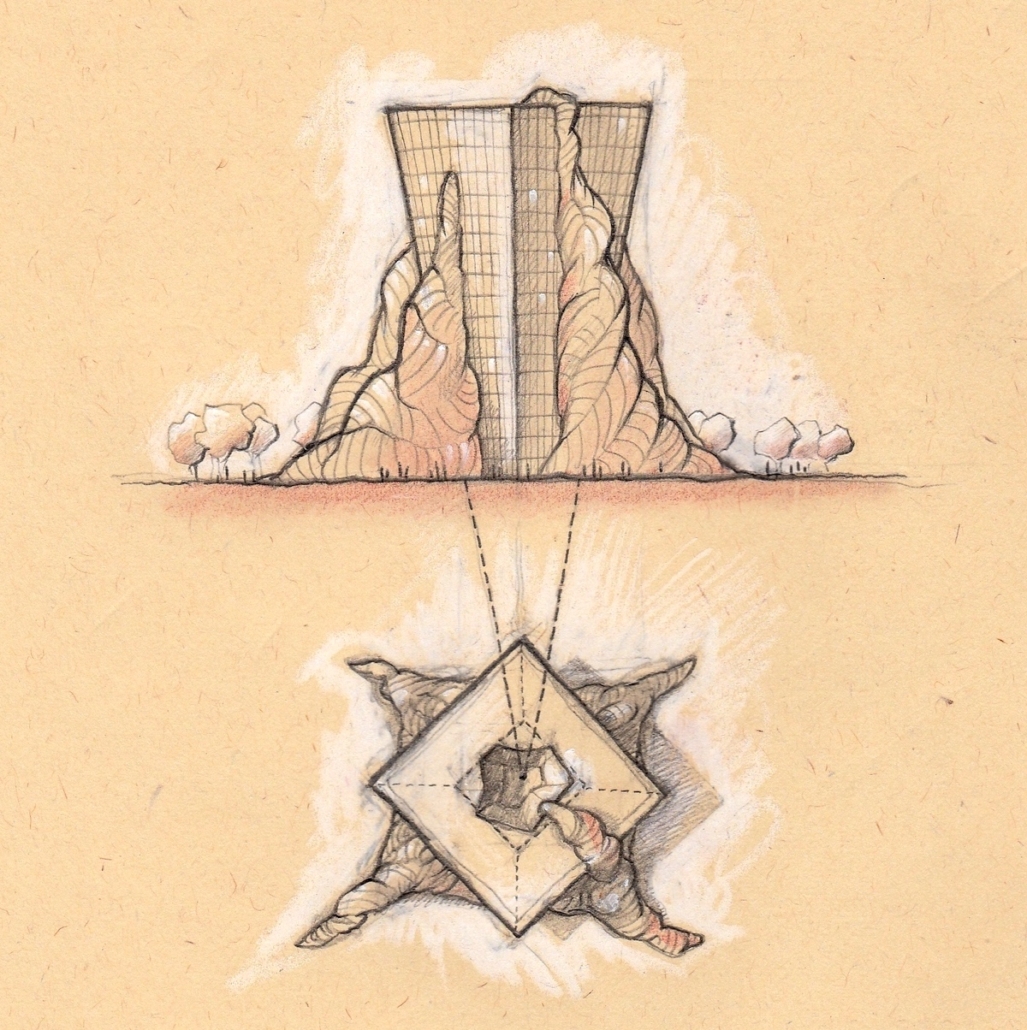
A single, brief example that may allow us to grasp some of the dynamics outlined above: we find ourselves in the Great Hall and, while strolling, we suddenly come across the structure — one of infinite possibilities — that corresponds to Italo Calvino’s The Baron in the Trees: “Rebellion cannot be measured by yards … Even when a journey seems no distance at all, it can have no return”; someone may recall the famous retort of Baron di Rondò to his son Cosimo. The Rampante, however, enacts his rebellion (“And I shall neve come down again!”) and sets a distance — a few inches, but they are an unbridgeable gap — that seems to be the beating heart of the story.
This is how Matteo Pericoli presents the architecture inspired by the Baron:
“The building’s supporting structure is made of a thick, load-bearing wall, which, as it rises, becomes a void, i.e. a gap separating two identical masses of glass and stone that penetrate each other without ever touching.” (p. 97)
Whether the reader is a loyal friend of the Baron or has unfortunately not yet met him, the literary architecture before him will succeed in making tangible one of the structural aspects of Italo Calvino’s novel and, then, it will be difficult to resist the desire to dive back into Cosimo’s leafy world or to rush to discover it for the first time.
Note: Thanks to Matteo Pericoli for granting and authorizing the use of images from his book.
https://matteopericoli.com/wp-content/uploads/2025/02/laletteraturaenoi.png2161028Matteo Pericolihttp://matteopericoli.com/wp-content/uploads/2017/12/Matteo-Pericoli-70-300x138.pngMatteo Pericoli2024-05-21 10:28:002025-02-21 10:36:31A Book-Building: The Museum of Literary Architecture
Dedicated to those who can’t give up design and architecture even in summer (and their children): 5 titles to experience the work of the big names in design
With summer and the vacations approaching, five freshly printed titles to pack (even for the little ones) that are beautiful and useful for traveling even through the work of great architects, designers, artists and, lo and behold, even writers. With a suggestion dedicated to those who, perhaps on a sailing boat, will have the opportunity to remember that ours is also a country of coastlines, harbors and – above all – lighthouses.
[…]
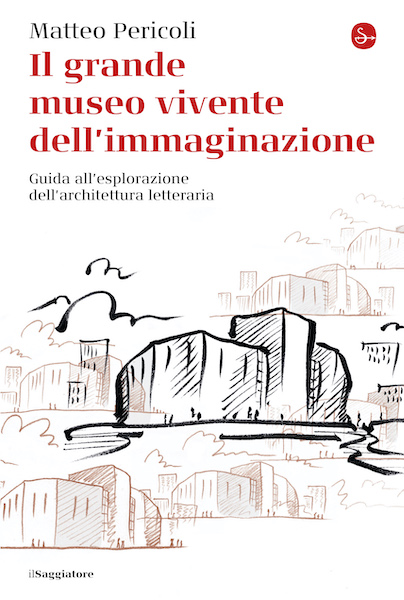
3. Il grande museo vivente dell’immaginazione. Guida all’esplorazione dell’architettura letteraria, by Matteo Pericoli (Il Saggiatore, 25 Euros)
Only an architect-illustrator (and son of art) with a dreamy stroke like Matteo Pericoli could think of turning great novels into buildings complete with entrances, floors, rooms, courtyards and exits. Where to show readers, as they go, -as in a guided tour- visions and architecture, stories and designs, fantasy and construction. From thatched huts to the Parthenon, from stone houses to the Guggenheim in New York, page after page, Matteo Pericoli takes readers on a journey through the works of Calvino and Annie Ernaux, Fenoglio and William Faulkner, Elena Ferrante and Jun’ichirō Tanizaki, to talk about them as if they were splendid and mysterious buildings.
Who will like it: bibliophiles, always on the hunt for new insights into authors and novels. And, of course, to those who look at architecture and interior design as disciplines that allow emotions, memories, and words to have their place as well.
https://matteopericoli.com/wp-content/uploads/2025/02/Interni.png2881062Matteo Pericolihttp://matteopericoli.com/wp-content/uploads/2017/12/Matteo-Pericoli-70-300x138.pngMatteo Pericoli2023-06-24 13:09:002025-02-21 13:16:255 books on architecture and design to read this summer
Matteo Pericoli
IL GRANDE MUSEO VIVENTE DELL’IMMAGINAZIONE
Guida all’esplorazione dell’architettura letteraria
pp. 166, € 25, il Saggiatore, Milan 2022
by Luigi Marfè
“If the architecture of a novel were a building,” asks Matteo Pericoli in The Great Living Museum of the Imagination, “what shape would it take?” After Finestre su New York (il Saggiatore, 2019) and Finestre sull’altrove (il Saggiatore, 2021), in this new book the author questions, through the exploration of a series of spatial metaphors, the visible forms of narrative creativity: that “clear impression,” as we read, “of feeling immersed in a kind of construction that has its own functioning and structure.” After all, literary theories have often used architectural imagery to describe compositional processes, from the method of loci of classical rhetoric to the constructive functions of formalism. “The house of fiction has many windows, but only two or three doors,” James Wood wrote more recently in How Fiction Works (2008). An architect, writer and illustrator, Pericoli is convinced that metaphors like this are not just abstract formulations, but on the contrary capture deep elements of the cognitive processes by which the mind imagines narrative universes. Each story, in his view, can be understood as a kind of space to be explored: “there are no stories that cannot be inhabited and inspected from within.”
The Great Living Museum of the Imagination is designed as a walk-through, a visit to an ideal museum about the creativity of architects and writers. “This is not just another book. It is a building,” the author writes: instead of different parts there are floors, instead of chapters as many rooms. Enriched with images, maps and photographs, the book is an iconotext, aiming to re-accustom the reader’s gaze to the observation of physical and mental spaces. Pericoli reflects on the relationship between narrative composition and architectural design, gives a visual reading of some narrative classics, and offers exercises in narrative creativity. Like the imagination of writers, the imagination of architects, he seems to suggest, does not follow objective rules, but is the result of subjective perceptions and intuitions. If there are “stories-that-are-spaces,” there are also “spaces-that-are-stories,” and orienting oneself in the world means trying to turn its pages: walking through a city, “we intuitively read paths, we are attracted by sudden, wide empty spaces, or by the light streaming in from the ceiling, or by a huge window.” The legibility of space is what allows the architect to give it form, composing the narrative surface on which to exercise his design: “The envelope of space is nothing more than the set of all those words, paragraphs and chapters, expressed in the language of architecture and used to articulate ideas, concepts, stories and aspirations.”
Every architect “tells a story.” Unlike those of writers, however, it is not configured as a “concatenation of events,” but of “spaces”: it is therefore an “architectural plot,” a “spatial narrative.” If architects have always fed on the imagery of writers, on the contrary the latter have sought in architecture a way to give visibility to their own narratives. Reading The Great Living Museum of the Imagination brings to mind Gaston Bachelard’s poetics of space, whereby words could be considered as “little houses” that the writer finds himself inhabiting, exploring, furnishing: “To climb the stairs of the house of the word means, from step to step, to abstract,” Bachelard wrote, “To descend into the cellar, means to dream, to lose oneself in the remote corridors of an uncertain etymology, means to search in words for unobtainable treasures.”
The “literary architectures” outlined by Pericoli concern works by Calvino, Ernaux, Vonnegut, Dürrenmatt, Conrad, Carrère, Saer, Ferrante, Tanizaki, Dostoevsky, Faulkner, and Fenoglio. His book is presented as an exercise in “arch-criticism,” if one can call it that, seeking in each text the visible form that best describes it. Pericoli is convinced that narrative imagination does not feed only on words: “There are in fact other thoughts – let’s call them intuitions – often made up of imagination or visualizations that are neither verbal nor causally produced by the reasoning we do.” Visual metaphors can be a gateway to this different dimension of creativity: “very often these thoughts or associations are triggered by metaphors which, if they work as such, are real engines of imagination and creativity that, literally, transport us elsewhere.”
Luigi Marfè teaches literary criticism and comparative literature at the University of Padua
https://matteopericoli.com/wp-content/uploads/2025/02/Lindice-Intersezioni-letterarie.png3861120Matteo Pericolihttp://matteopericoli.com/wp-content/uploads/2017/12/Matteo-Pericoli-70-300x138.pngMatteo Pericoli2023-02-15 16:15:002025-02-22 16:32:19Stories to inhabit
Matteo Pericoli Il grande museo vivente dell’immaginazione Guida all’esplorazione dell’architettura letteraria 168 pp, 25 € Il Saggiatore, Milan 2022
January 30, 2023
Who knows where Italo Calvino would have placed a book like this: among the Books That Are Missing To Put Next To Others On The Shelf, or the Novelties Whose Author Or Topic Attract Us? We like to think that the author of If One Winter’s Night a Traveler would have placed The Great Living Museum of the Imagination among the Books That Inspire Sudden, Frantic And Not Clearly Justifiable Curiosity.
More than a book, in fact, it is a guidebook; a Guide to the Exploration of Literary Architecture. There are Maps (Ground Floor, First and Second Floor), a Legend of Spaces (Entrance, Rooms 1 and 2, and Inner Courtyard). And there is a guide, of course: the author himself – speaking in a voice that is not his, but ours (but we will understand this as we read on…). A guide who, instead of escorting us along a series of obligatory steps, as a first thing wants us to feel free; free to go where we please, observe what we please, and, most importantly, imagine what we please. He is quick to reiterate, in fact, that “museum” comes from “mūseóon,” meaning the place sacred to the daughters of Zeus where one could contemplate and imagine in full autonomy.
But what is literary architecture? It is an ongoing discovery. Not only that: an attempt to increase our awareness when we relate to spaces (and the void). More: a series of educational workshops that, over the past twelve years, architect, designer and author Matteo Pericoli has held around the world; from Turin (where it all began) to New York, via Dubai.
Inspired by the discovery of a lexicon common to both architecture and literature – how many times have we heard, about a story endowed with uncertain logical connections, that it “lacks structure,” “wobbles,” or “doesn’t stand up”? -, Pericoli has traversed the history of architecture as an attempt to narrate; at first simple, then increasingly complex.
What is the impulse that unites the first hut – when the basic idea was that of a “roof-over-the-head-so-I-don’t-get-wet” – to the first “house-with-a-window” – an “architectural element that connects what is tangible (the frame itself) with the intangible (the view, the outside) and thus the real with the imaginary, the everyday with the absolute” – if not a narrative impulse, the incipit of a story destined irrevocably to complicate itself?
Alice Munro writes: “A story is not like a road to follow … it’s more like a house. You go inside and stay there for a while, wandering back and forth and settling where you like and discovering how the room and corridors relate to each other, how the world outside is altered by being viewed from these windows.”
By stripping architecture of its least relevant elements – the style, the name of the person who designed a certain project, its historical value – Pericoli shows us the spot where the essential lurks; that which “can neither be touched (the space) nor read (the architecture of a story).” Removing the walls, ceilings, windows, etc., removing the envelope, in short, what is left but a void, the void? And setting aside the words, sentences, punctuation and paragraphs of writing a story, what is left but an essence that “can only be intuited and deduced,” as when we confront the ghostly voice of Kurtz in Conrad’s Heart of Darkness, or try to intuit the subject matter of the dialogue between the girl and the American in Hemingway’s Hills Like White Elephants.
Having delved into these reflections from a theoretical point of view – Room 3 contains an enlightening lecture on creative writing; Room 4 reiterates the importance of reading as a wonder-generating activity -, Pericoli, with his characteristic lucidity and politeness, invites us on a tour of the Great Hall where it is possible to view no less than twelve interpretations of literary architecture. Then, a moment before the bookshop (unfailing: as in any museum), he gives us instructions for making our own literary architecture so as to display it in our own, very personal living museum of the imagination. (And reminds us, too, that in architecture it makes little sense to distinguish between “expert” and “non-expert” people, since we all experience our relationship with space.) The only rule in this game – because there are no games without rules – is to always maintain a literary approach, never a literal one. What are we to do with a model of a lighthouse if what we are actually excited about is the dense web of relationships that governs the behavioral dynamics of the Ramsay family during a famous trip to the Isle of Skye? Why not give it a try, then? In between reflections, we may be able to free ourselves “from the inevitable burden given by preconceptions and preclusions due to the judgments and interpretations of others,” and discover something new about the mysterious relationship between architecture and literature. And, why not, about ourselves.
https://matteopericoli.com/wp-content/uploads/2023/01/Lindice.png6581010Matteo Pericolihttp://matteopericoli.com/wp-content/uploads/2017/12/Matteo-Pericoli-70-300x138.pngMatteo Pericoli2023-01-30 16:24:002025-02-22 16:34:31What structure over there awaits the end?
Matteo Pericoli’s book stems from his “Laboratory of Literary Architecture” From Dostoevsky to Ferrante, drawing becomes a form of alternative reading
by Mario Baudino
Conceiving and drawing houses and buildings starting from great literature is not just a game, although maybe we have even done it, sometimes, fantasizing about a novel or a short story: perhaps, however, we have never gone further on this interpretive road, we have not made it concrete. Matteo Pericoli, on the other hand, has been working on this intuition for years now. He had started out with an idea borrowed from Alice Munro, the Canadian writer much admired for her short stories, who had once described ́”stories” not as roads, that is, not as vector narratives, one-dimensional paths with a beginning and an end, but as ́”houses,” entirely three-dimensional – and to be inhabited, and has now come to construct a book of fantastic texts and buildings, The Great Living Museum of the Imagination (Il Saggiatore) a very elegant book that ideally summarizes a long process of workshops around the world (and started at the Scuola Holden in Turin) and presents a wide range of results: stories turned into buildings, reading as a way of living.
Transfigurations that narrate their relationship with the world as living characters
Many avid readers know that they have often had the experience of ́”falling” into a book, and of changing dimensions. Writers, just as often, invite them to precisely this space-time dislocation, when urban architecture narrates their relationship to the world as if they were characters. The examples are countless, some as memorable as the incipit of Ferragus, the first story of History of the Thirteen, where Balzac gives the floor to the Parisian streets, those disgraced or noble, murderous or “older than certain very old ladies,” respectable, clean or always dirty, working-class, trading; because ́”the streets of Paris have human qualities, and by their physiognomy they imprint in us certain ideas from which it is difficult for us to escape.” He is not the only one, of course. Something like this happens in Dickens (read perhaps Bleak House, where a dilapidated and infamous London street behaves like a human being).
Matteo Pericoli has gone further, that is, he has decided instead to make the works of literature speak as if they were as a whole pieces of architecture, aiming not, as he says in the preface of his book, “at that natural instinct we have to imagine or visualize the settings described in the novel, but at that distinct impression of feeling immersed in a kind of construction that has its own functioning and structure.” Drawings, models, fantastic buildings, like Calvino’s cities, are in turn embedded in a super-architecture, that of the “book-museum” (“This is not a book like any other,” he writes, “It is a building”) that houses them: without temptations of “realism” or flat verisimilitude. If we take Heart of Darkness, the magnificent Conradian tale, it is certainly not transformed or described as a hut in the forest: instead, the building into which it is transformed is an inverted pyramid down to many feet below the ground. So for the twelve authors on whom Pericoli worked: they are not arranged as nativities, but as symbolic transfigurations.
“Heart of Darkness” by Joseph Conrad becomes an inverted pyramid down to many feet below the ground (from Pericoli’s book)
Elena Ferrante (My Brilliant Friend) splits into two buildings that perhaps support each other (and this representation, all things considered, is perhaps the most obvious), Dostoevsky’s White Nights becomes a skyscraper tilted above a kind of labyrinthine checkerboard, Beppe Fenoglio’s Ruin is a house entirely made of roots, a building that grows “underground,” Italo Calvino’s The Rampant Baron is something that contains a sense of unbridgeable distance, a house with a gap visible only from above (because as Cosimo Piovasco’s father says, “rebellion is not measured in meters”). There are also, regenerated and displaced with the work of spatial construction, Annie Ernaux, William Faulkner, Junichirο Tanizaki, Kurt Vonnegut, Friedrich Dürrenmatt, Emmanuel Carrère, Juan José Saer, testifying that the process can work on any narrative, on any “story” – with one eye toward the other story, that of architecture, and another toward the possible paradigm of “architecting.”
“We have a natural instinct to imagine and visualize”
“These structures you will encounter,” Pericoli writes, “will take the form you want them to … that is, the form based on your reactions, intuitions and ideas. Each one different for each of you, a multiverse of forms.” The result is a very stimulating reading path-because then Pericoli’s Museum of the Imagination is indeed a “museum” but meanwhile it is a book, not a catalog but a history of stories, especially if one thinks of the sometimes casual and ideological use that one tends to make in public discourse of the classics of today and yesterday: a very bad habit because the risk then becomes that of making of them not free and fantastic constructions, but sad and very boring prisons. —
https://matteopericoli.com/wp-content/uploads/2023/03/La-Stampa-Cultura.jpg437846Matteo Pericolihttp://matteopericoli.com/wp-content/uploads/2017/12/Matteo-Pericoli-70-300x138.pngMatteo Pericoli2023-01-26 16:43:502023-11-10 17:09:19A walk through twelve masterpieces “These stories are fantastic palaces.”
We use cookies to ensure that we give you the best experience on our website. If you continue to use this site we will assume that you are happy with it.OK




 The Great Living Museum of the Imagination is designed as a walk-through, a visit to an ideal museum about the creativity of architects and writers. “This is not just another book. It is a building,” the author writes: instead of different parts there are floors, instead of chapters as many rooms. Enriched with images, maps and photographs, the book is an iconotext, aiming to re-accustom the reader’s gaze to the observation of physical and mental spaces. Pericoli reflects on the relationship between narrative composition and architectural design, gives a visual reading of some narrative classics, and offers exercises in narrative creativity. Like the imagination of writers, the imagination of architects, he seems to suggest, does not follow objective rules, but is the result of subjective perceptions and intuitions. If there are “stories-that-are-spaces,” there are also “spaces-that-are-stories,” and orienting oneself in the world means trying to turn its pages: walking through a city, “we intuitively read paths, we are attracted by sudden, wide empty spaces, or by the light streaming in from the ceiling, or by a huge window.” The legibility of space is what allows the architect to give it form, composing the narrative surface on which to exercise his design: “The envelope of space is nothing more than the set of all those words, paragraphs and chapters, expressed in the language of architecture and used to articulate ideas, concepts, stories and aspirations.”
 review by Francesco Gallo