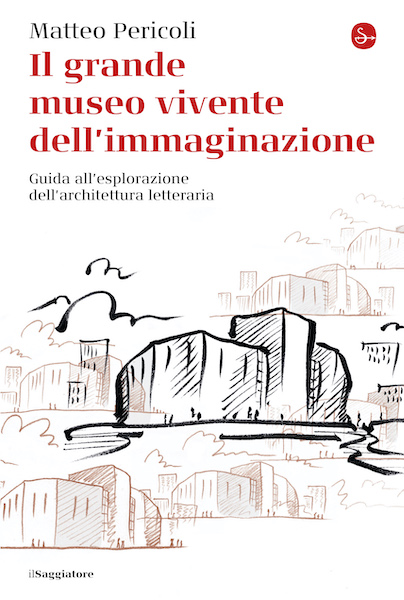
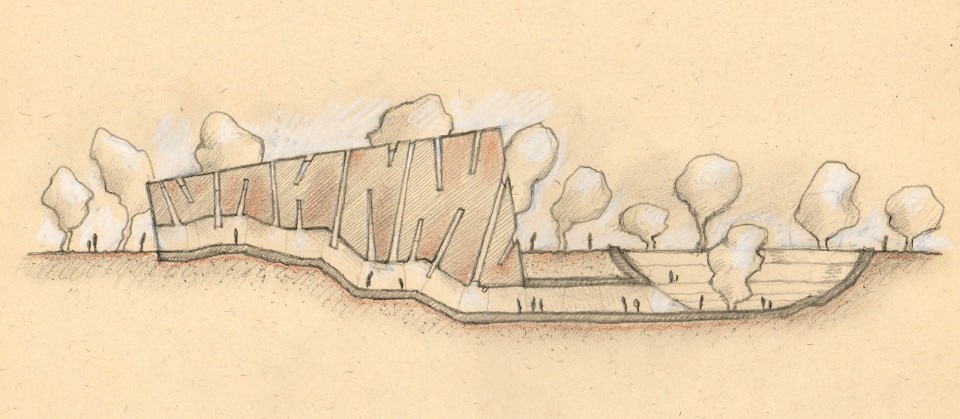
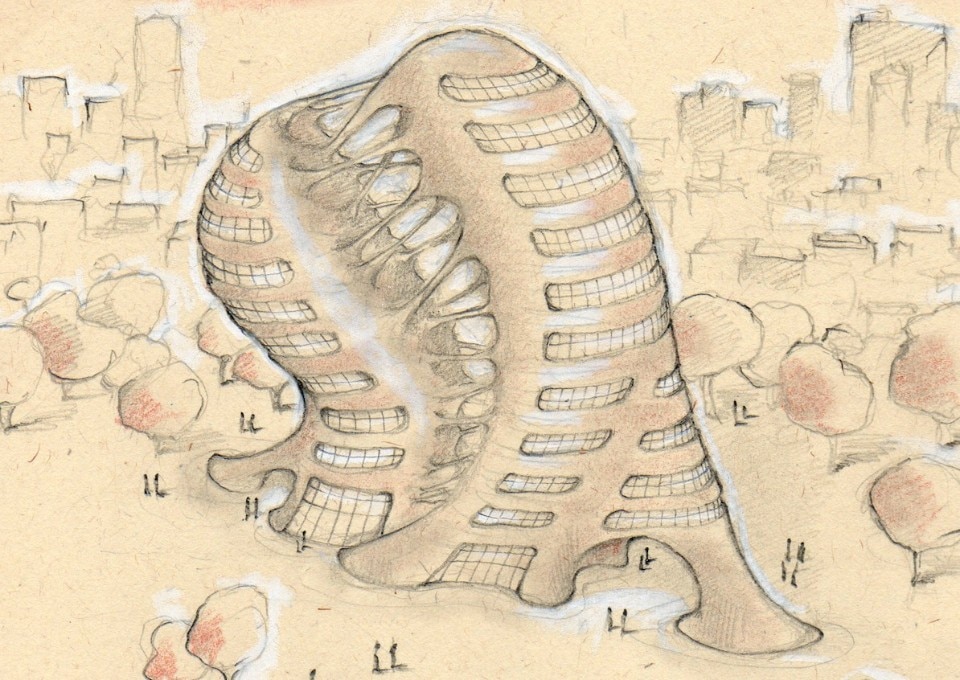
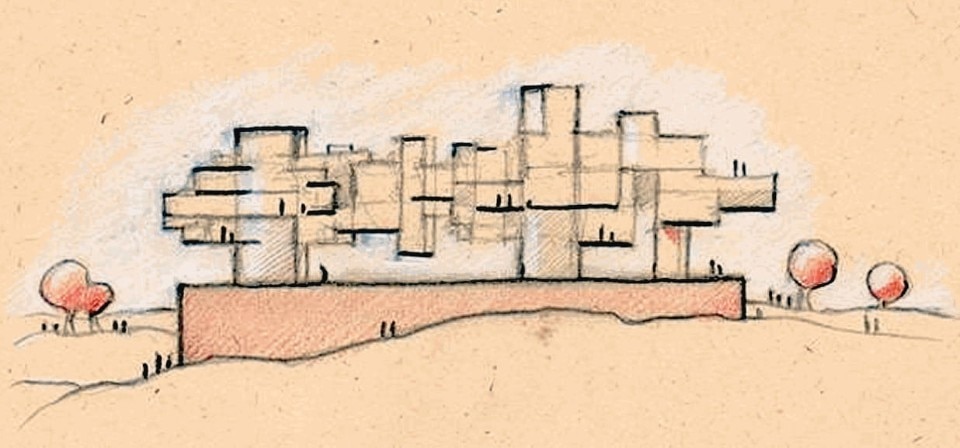
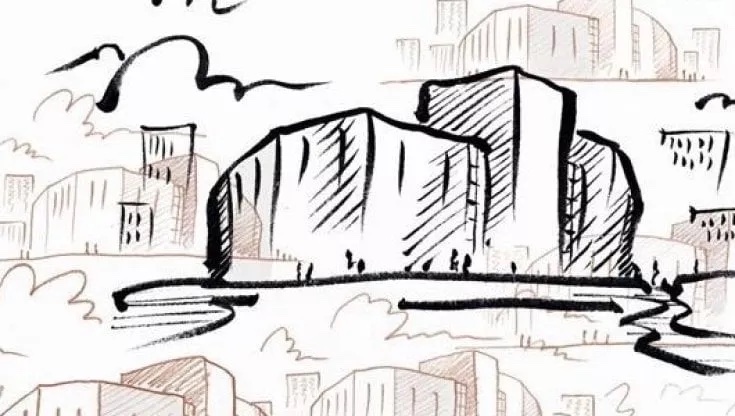
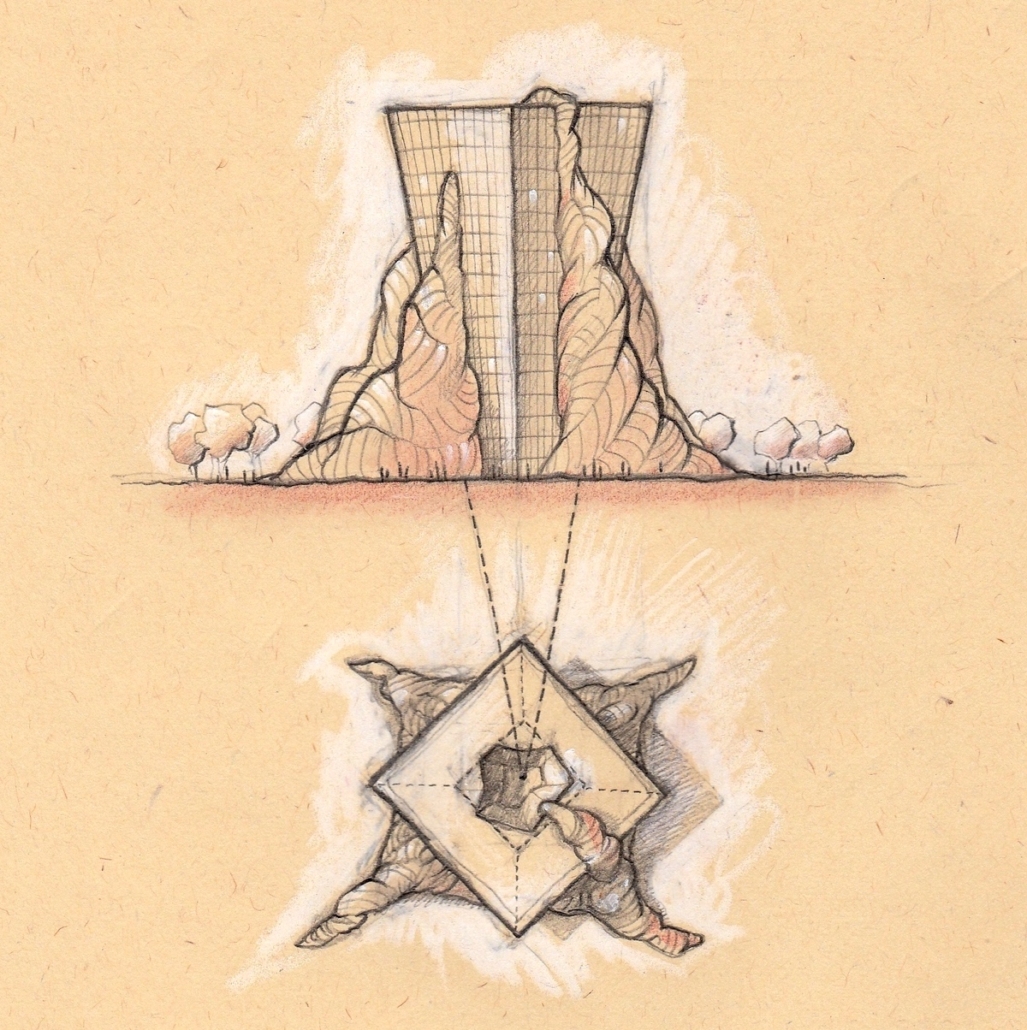
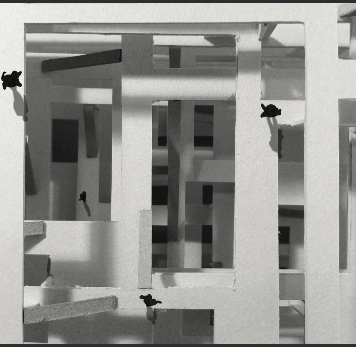
Architect, illustrator and author, in 2010 Matteo Pericoli started his Literary Architecture Workshop, which invites participants to transform short stories and novels into architecture. It is not a matter of imagining or giving shape to the locations and environments that the writing narrates, but rather of understanding the very structure of the story and translating it into a building. A meta-literary exercise in which the author’s narrative construction acquires, in the hands of the reader, concreteness in the form of drawings or models. The book itself, which contains twelve examples referring to as many novels, such as Heart of Darkness (Conrad), The Adversary (Carrère) or The Years of Annie Enraux, developed by Pericoli himself, is presented as an architectural structure, specifically a museum in the Greek sense of the term as a place sacred to the Muses, ideal for inspiration and contemplation. The buildings that arise from the Laboratory are by necessity subjective. For example, in front of Amy Hempel’s short story The Harvest, which twice recounts a car accident in which the writer herself is a victim – though the second story begins with the unsettling words “I omit many things when I tell the truth” – two groups participating in the workshop imagine different buildings, though both as deceptive-looking as the story, with unexpected spaces, columns that do not hold anything up and furniture elements – made of concrete – that are instead the real structures of the building. Surprising in many ways, Il grande museo vivente dell’immaginazione makes you want to try it yourself, with a beloved short story, drawing paper, colored pencils, cardboard, glue and scissors.
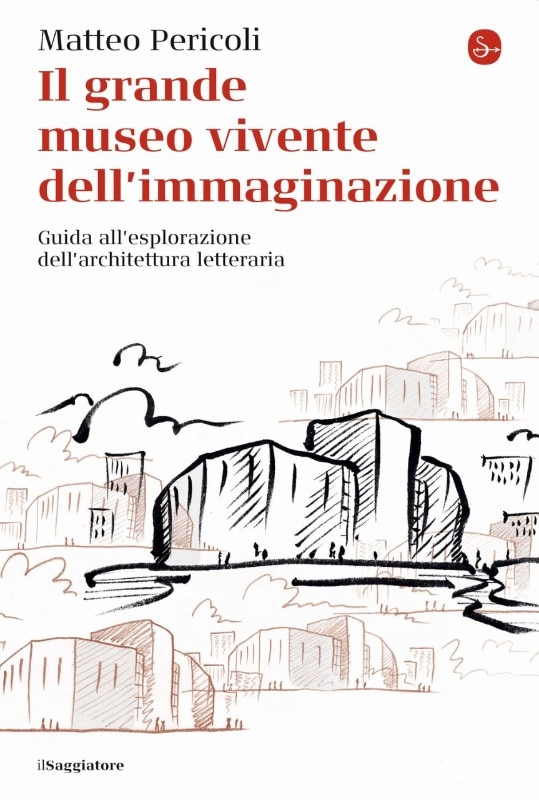
Il grande museo vivente dell’immaginazione Matteo Pericoli Il Saggiatore, Milan, 2022 166 pages, 25 euros ISBN 978-88-428-3218-8
“What if these kinds of spaces, which we will call ‘literary architecture’, were narrative structures turned into actual architectural structures? Why not take the architecture of a story and turn it into a building?” (M. Pericoli, Il grande museo vivente dell’immaginazione. Guida all’esplorazione dell’architettura letteraria, Milano, Il Saggiatore, 2022, p. 16)
On the threshold
Upon entering the Great Living Museum of the Imagination, we feel the distinct impression that someone is taking us by the hand and leading us along a path with a sure hand, yet able – at the same time – to respect our time (our pace), to let us move freely without, however, ever losing sight of us. The voice that guides us is that of Matteo Pericoli, an architect, illustrator and author who succeeds, in this book-museum, in cultivating a fertile middle ground, that of Literary Architecture, a dimension that cannot be ascribed to a new form of architecture or literature. The book, in fact, has sprouted from the more than decade-long experience of The Laboratory of Literary Architecture (lablitarch.com), an experience of true unearthing of a still unexplored territory. Upon scrolling down the first page we feel a tear, we immediately become readers who, while reading, become visitors to a space, immersed in a construction “that has its own functioning and structure.” Play within play, Matteo Pericoli thus leads us to live a twofold experience: that of readers/visitors exploring a space that houses Literary Architecture and, simultaneously, that of those who can experience firsthand what happens when – thanks to words (written, but, above all, read) – an architectural structure inspired by a novel or a story takes shape.
The Tool Bag
Upon entering the book-building, we can explore the environments that make up an itinerary that gradually introduces the reader/visitor to Literary Architecture. A succession of spaces unravels between the entrance to the Museum and the exit, leading the reader through progressively illuminated and illuminating environments: if in the first section of the text (Ground Floor and First Floor) the author presents the theoretical-structural elements of Literary Architecture, in the second section (Second Floor), on the other hand, a wide selection of literary architectures inspired by well-known or lesser-known novels finds its place (each architecture is accompanied by a short text introducing both the novel in question and the particular interpretative insight that gave rise to that very architecture). We are dealing, then, with a book that provides both the tool bag to use and, later, some examples that the reader can read/watch to approach the middle ground of literary architecture.
The theoretical dimension of the experiment is presented by drawing on the previous (and current) experience of the reader who is constantly urged to question the act of reading, its potential, and what can happen to anyone who reads a short story or a novel not only by visualizing what he or she reads, but by sensing that he or she is situated in a (literary) space that can be translated into formal structures precisely because it itself consists of architectural elements; in fact, Matteo Pericoli argues that literary architecture arises when disciplinary boundaries blur and one begins to perceive architecture as a spatial narrative and, simultaneously, the literary text as the construction of a space:
[…] these thoughts occur when we least expect it and above all when we allow our mind to move freely and silently, without taking anything for granted, without prejudices or any particular goal, and, above all, without fragmentation […] (p.27)
The fragmentation to which the author refers concerns both the jealous claim of disciplinary boundaries and the simultaneous breakdown of the reading experience into specific skills that go to reduce/depower the revolutionary impact that reading a text can provoke in the reader.
Matteo Pericoli thus relies, on the one hand, on the characteristics of the literary text and, on the other hand, on the creative potential of reading; the fruitful encounter between reader and literary text can thus open up the possibility of literary architecture as another dimension, as a bridging reality, constantly suspended between word and image, a reality that allows us to insinuate ourselves “through the written words and feel with your whole body that, on the other side, there is a kind of parallel universe. There is a world that is all yours where the stories and their structures — the architecture of novels and poems and literary texts in general — are not just metaphors or abstract theories, but real constructions, meticulously built, word by word, paragraph by paragraph.”
The game is done
The second section of the Book-Museum — the one devoted to the twelve literary architectures presented in the Great Hall and punctuated by the binary rhythm given by the brief introductions to the novels and the images of the literary architectures prompted by the reading of those texts — allows the reader to directly experience the alienating effect caused by the translation of novels into forms that are articulated in space: Ernaux, Faulkner, Fenoglio, Tanizaki are just a few of the writers summoned. Here the reader experiences what Matteo Pericoli has been arguing from the very beginning of his journey, namely that architecture is a universal experience, one that goes beyond specialized knowledge because we all, from time immemorial, experience space, pass through it, live it, just as we all – though not scholars, literary critics, though not mastering any specific knowledge – are readers who can discover a new dimension of reading.
A single, brief example that may allow us to grasp some of the dynamics outlined above: we find ourselves in the Great Hall and, while strolling, we suddenly come across the structure — one of infinite possibilities — that corresponds to Italo Calvino’s The Baron in the Trees: “Rebellion cannot be measured by yards … Even when a journey seems no distance at all, it can have no return”; someone may recall the famous retort of Baron di Rondò to his son Cosimo. The Rampante, however, enacts his rebellion (“And I shall neve come down again!”) and sets a distance — a few inches, but they are an unbridgeable gap — that seems to be the beating heart of the story.
This is how Matteo Pericoli presents the architecture inspired by the Baron:
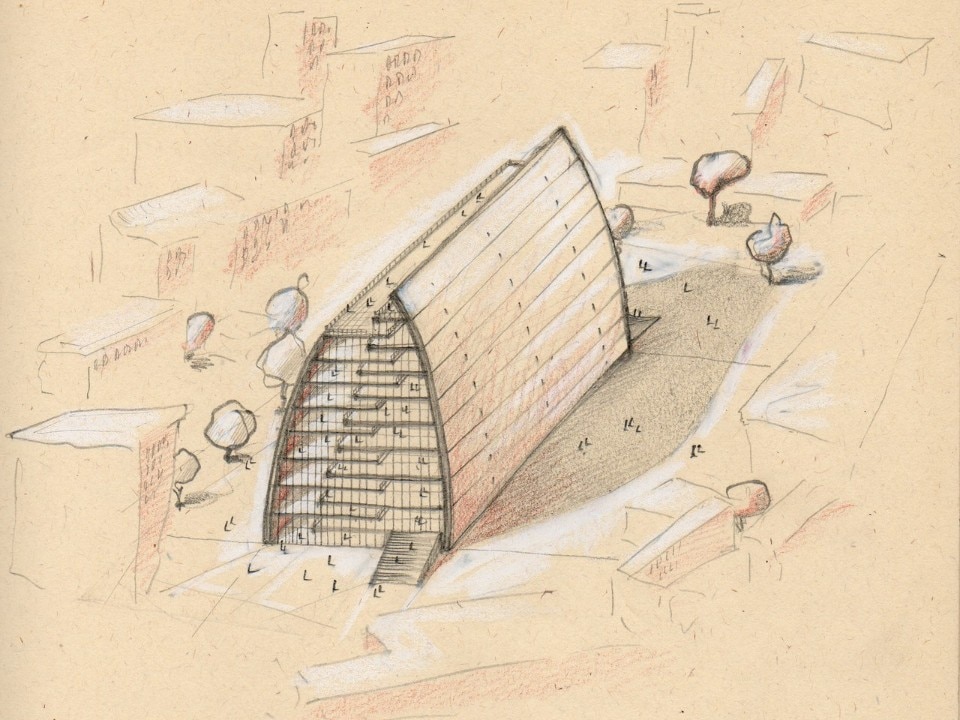
“The building’s supporting structure is made of a thick, load-bearing wall, which, as it rises, becomes a void, i.e. a gap separating two identical masses of glass and stone that penetrate each other without ever touching.” (p. 97)
Whether the reader is a loyal friend of the Baron or has unfortunately not yet met him, the literary architecture before him will succeed in making tangible one of the structural aspects of Italo Calvino’s novel and, then, it will be difficult to resist the desire to dive back into Cosimo’s leafy world or to rush to discover it for the first time.
Note: Thanks to Matteo Pericoli for granting and authorizing the use of images from his book.
https://matteopericoli.com/wp-content/uploads/2025/02/laletteraturaenoi.png2161028Matteo Pericolihttp://matteopericoli.com/wp-content/uploads/2017/12/Matteo-Pericoli-70-300x138.pngMatteo Pericoli2024-05-21 10:28:002025-02-21 10:36:31A Book-Building: The Museum of Literary Architecture
The Great Living Museum of the Imagination written by Matteo Pericoli guides us in the exploration of literary architecture
by Mario Gerosa
Every building architecture preserves a story within itself, it tells something that escapes the obvious idea of functionality. Of course, every house, building, palace or castle first and foremost serves the housing needs of those who must inhabit it, and in most cases it also responds to precise typological canons. Finally, it refers back to the proportions associated with the dimensions of man, normed by the drawing of the “uomo leonardesco” as well as by Le Corbusier’s Modulor.
But there are also intangible buildings that constitute a multifaceted separate universe, and there is also an inner voice of architecture, be it literary or built from mortar and bricks, that refers to a narrative, often developed on the basis of the sedimentations and stratifications of emotions felt by the visitors who have been there.
All these concepts have been brought out by Matteo Pericoli, an architect and illustrator, who in 2010 founded the Laboratory of Literary Architecture (www.lablitarch.com), “a multidisciplinary exploration of narrative and space,” an important and authoritative point of reference for studies in this field presented at numerous conferences and workshops around the world.
Pericoli systematized a whole series of thoughts and reasoning related to a transversal view of the art of building in The Great Living Museum of Imagination (Il Saggiatore).
The book is structured as a guided tour inside a macro-architecture composed of many buildings, which define an ideal gigantic complex. As if we were in a physical space, the exposition progresses through a series of spaces in which the reader can feel at ease, recognizing a familiar sequence: the museum of literary architecture conceived on paper by Pericoli comprises three floors, with an entrance hall, five rooms, a great hall, and a courtyard. On the first two floors, the reflection on spaces examines many existing pieces of architecture, from the Pantheon to the Guggenheim Museum, from the Parthenon to Villa Savoye, interweaving and intersecting considerations related to examples of literary architecture. From an increasingly tight and compelling comparison, assonances and affinities emerge between the written and built architecture.
A step toward the beyond
In another chapter, that of the Second Floor, we move into the territory of literary architecture, with individual examples dedicated to the architectural inventions of twelve major authors, from Calvino to Dürrenmatt via Vonnegut. The deeper one delves into the reading, the more the boundaries between the two kinds of architectures blur, the built one, which for convenience, with a misnomer, one may call “real architecture,” and the other, the literary one.
“True architecture” is a curious expression, Pericoli notes. “As if there is one that is ‘not true,’ and therefore ‘false’? ‘fake’? ‘not real’? ‘intangible’? After all, architecture is to construction like writing is to typing, or the act of writing. The architect is not ‘needed’ for building (many can and just do that), just as the writer or writer is not ‘needed’ for composing sentences, words, texts. So there is perhaps the idea —, much shared and perhaps even legitimate — that on the one hand there is ‘literary architecture,’ immaterial, intangible, perhaps simply the result of some mental or intellectual endeavor, and on the other hand there is ‘real architecture,’ that is, the built, tangible, firm, fixed, objective architecture. And that the two are divided, separated. Here, I strongly believe instead that once we surrender to the idea that a story is like a house, a house to explore, to inhabit, from whose windows we see a changed world, which changes, as we change with each new visit and which is therefore something ‘real,’ as real as our experiencing of architecture, of space, of movement, of proportions, the changes of level, the ascents, descents, openings, darkness, clarity, and so on, then we are ready to read how narrative impregnates everything, it is everywhere, and it is a founding component of the architectural space that we read and perceive on a daily basis, just as we store in our minds the functioning of a story or literary text in general. Here we have to beware of the main misunderstanding: not how we perceive and read, and thus imagine, what a story describes to us (its settings, places, landscapes, its characters, how they are dressed, etc.), but how we learn to move within that construction, which is the product of how the story was constructed (according to us and our inclinations) — thus its materials, its syntax, its voice, its grammar, its cultural context, the references on which it rests, and so on.Literary architecture can give us that sense of confidence in discovering with ease, and perhaps pleasure, the narrative of architectural spaces, how they concatenate, how they reveal themselves to us — to us in relation to our inclination and our reading — and not (or not only) the story of how these buildings came to exist.”
All of these concepts emerge in the book, designed as a compelling architectural promenade between different types of buildings. But what are the literary architectures that have most struck Matteo Pericoli’s imagination?
“I have visited a huge number of literary architectures, buildings constructed either after I read the texts myself, and thus ‘designed’ them in my mind, or after readings and designs made by others. The ones that struck me most were perhaps those that concealed insights and ideas whose form could only be expressed in that way, that is, through architecture, and not through the use of words. The beauty of this approach, or method, or vision however one wishes to call it (that of the Laboratory of Literary Architecture), is that once one is on the “other side,” the side beyond words, in the place where the text is a series of architectural forms and spaces, thus wordless, to be manipulated and explored with freedom and ease, one has access to that state of mind, which usually lasts but an instant, in which our ideas have a shape before they have content.
A project by a group of high school students comes to mind. They were working on Ernest Hemingway‘s short story Hills Like White Elephants, and for them the crucial element, the fulcrum around which the story, the text, the protagonists and their reading revolved, was the weight of the decision as to whether or not she will do an intervention, a ‘small operation,’ which the two protagonists fervently discuss without describing in detail. The architecture of this group of kids is a plaza at a lower level of the city, where we are driven to descend (we are attracted by emptiness) and on which hangs, suspended, a huge black cube, the weight of the decision, at such a height and position that it causes a sense of both discomfort and curiosity. The idea of the two protagonists is not present in the project, and already this seemed to me beautiful and strong. But the thing that struck me most, for clarity, strength, elegance, and sophistication of thought, was that the tie-rods that hold that cube in suspension, tie-rods of different lengths from each other because of the off-center and asymmetrical position of the volume in relation to the whole, work (literally work) differently, some are tighter and under greater tension, others less so. Those different tensions represent the various moments of tension in the dialogue between the two protagonists that definitely does not work.“
It is evident in the book that there is always a distinct sense of narrative in literary architecture. One wonders if this narrative dimension is also found in built architecture.
“Just as every story that, from the moment it leaves the pen or the table of the writer and is let go, must necessarily have its own architectural structure, so every piece of architecture is necessarily imbued with narrative. Whether this happens consciously or unconsciously is irrelevant. There are those who write with a strong inclination toward the architectural design of the text they are constructing, and there are those who write instead letting their instincts guide them or move them by who knows what other ‘forces.’ But, in the end, the product is a structure that will have to ‘stand’, either well or badly, in order to be read. Turning the tables, much of the decisions that architects make, whether consciously or unconsciously, can be likened to those that the writer must make: how to meaningfully concatenate spaces? How to reveal the main space? How to use the clarity given by light? How to create surprises or expectations? How to make evident or hide the structure that supports the whole? How to use, if desired, linguistic references related to the past? (And to what past?). What form, and thus voice, to give to the whole?“
It still remains to be understood in which buildings the narrative component is most relevant.
“In all of them,” Pericoli states. “In architecture, the ‘narrative component’ is inextricable from any compositional decision. In the museum-book, on the First Floor, in Room 3, I say, ‘the choices one makes when composing architectural structures are qualitatively very similar to those made by someone who is narrating a story.'”
And then begins this long list of (self-)questions and answers:
“For example: isn’t positing an entrance on the side instead of in the middle a narrative choice? Yes, because by entering the ‘narrative space’ from the side we perceive it differently, the perspective changes. But then is raising or enlarging a window also a narrative choice? Yes, because somehow we change the relationship that exists between inside and outside, as well as the amount of information that can be ‘read.’ And is moving the visitor from a square room to a rectangular one a narrative choice? Sure, because they will perceive either an expansion or contraction of space (depending on the orientation of the rectangle). And is deciding whether or not to set back the front of a building from the street it faces a narrative choice? Well, yes, because it is like making explicit the relationship with which that building (then it depends on what kind of building it is: a house, a church, a bank, a museum, a skyscraper) stands in relation to the context, how and how much you want to highlight this relationship. What about the decision whether or not to incorporate a large tree into the structure of a building? It is a very strong narrative choice; it clearly tells what you believe the relationship between artifact and nature should be. And is the height of a wall dividing two communicating rooms a narrative choice? Yes, because the height will have a direct effect on what you will be able to read or glimpse or imagine about the other space; plus, it is a clear way of telling us whether you intend for the two environments to be perceived as linked or divided. What about setting back an entrance to make room for a porch? You see it on the ground floor in Room 1 with the Pantheon; it’s like retreating or postponing a beginning, a kind of introduction. And are providing soft lighting and deciding whether to do it with direct or indirect light narrative choices? Light, another material among the many narrative devices at an architect’s disposal, projects clarity or can deceive by excess or defect; it is directly related to clarity of exposition. And is the repetition of nearly the same structural elements (such as my repeating ‘it’s a narrative choice’) amidst the progression of a series of varying volumes a narrative choice? Of course, if used carefully it is a kind of architectural anaphora.”
Dedicated to those who can’t give up design and architecture even in summer (and their children): 5 titles to experience the work of the big names in design
With summer and the vacations approaching, five freshly printed titles to pack (even for the little ones) that are beautiful and useful for traveling even through the work of great architects, designers, artists and, lo and behold, even writers. With a suggestion dedicated to those who, perhaps on a sailing boat, will have the opportunity to remember that ours is also a country of coastlines, harbors and – above all – lighthouses.
[…]
3. Il grande museo vivente dell’immaginazione. Guida all’esplorazione dell’architettura letteraria, by Matteo Pericoli (Il Saggiatore, 25 Euros)
Only an architect-illustrator (and son of art) with a dreamy stroke like Matteo Pericoli could think of turning great novels into buildings complete with entrances, floors, rooms, courtyards and exits. Where to show readers, as they go, -as in a guided tour- visions and architecture, stories and designs, fantasy and construction. From thatched huts to the Parthenon, from stone houses to the Guggenheim in New York, page after page, Matteo Pericoli takes readers on a journey through the works of Calvino and Annie Ernaux, Fenoglio and William Faulkner, Elena Ferrante and Jun’ichirō Tanizaki, to talk about them as if they were splendid and mysterious buildings.
Who will like it: bibliophiles, always on the hunt for new insights into authors and novels. And, of course, to those who look at architecture and interior design as disciplines that allow emotions, memories, and words to have their place as well.
https://matteopericoli.com/wp-content/uploads/2025/02/Interni.png2881062Matteo Pericolihttp://matteopericoli.com/wp-content/uploads/2017/12/Matteo-Pericoli-70-300x138.pngMatteo Pericoli2023-06-24 13:09:002025-02-21 13:16:255 books on architecture and design to read this summer
With his drawings of Manhattan, Matteo Pericoli won New Yorkers over (and then the rest of the world), then went back to Italy, to Turin, to work on architecture, stories, and their relationship.
by Manuel Orazi
Many in literature have used the metaphor of architecture, especially to shape the structure of a novel; however, very few have done the opposite: imagining architecture as a narrative structure. This is the original interpretation of Matteo Pericoli, a man who, after leaving his profession in architecture, backed into it again.
After graduating from Politecnico di Milano university under Wolfgang Frankl – one of Mario Ridolfi’s historical collaborators – right before his passing, Pericoli moved to New York to work for Peter Eisenman for a brief period and then for Richard Meier. Between 1995 and 2008, the Big Apple was the setting for his metamorphosis from architect to illustrator; he conquered the city that never sleeps, which he drew from the outside first and the inside after (in Manhattan unfurled and Manhattan within).
What if the architecture of a novel were a real building – that is, it had a physical, tangible structure made of more than just words – what shape would it take?
Annie Ernaux, Les années
Paul Goldberger, then critic for The New Yorker, wrote that Pericoli managed to win New Yorkers over because he was the first to gather the entire urban profile of the island in a single roll, to draw Manhattan as if it were a town from his birth region. After many years and many other literary adventures that brought him to work with some of the most renowned international newspapers, Pericoli went back to Italy, but not to Marche, the region where his family is originally from, but to Turin.
Elena Ferrante, My Brilliant Friend (L’amica geniale)
There, he found the Scuola Holden, where he proposed a completely new way of perceiving literature: “stories need to be experienced mentally before they can be written.” So, are stories landscapes, are they doors? “Not really, a story is not like a road to follow… it’s more like a house. Like the Nobel price Alice Munroe explained, you go inside and stay there for a while, wandering back and forth and settling where you like and discovering how the room and corridors relate to each other, how the world outside is altered by being viewed from these windows. And you, the visitor, the reader, are altered as well by being in this enclosed space, whether it is ample and easy or full of crooked turns, or sparsely or opulently furnished.”
So you can even go back again and again, of course, “the house, the story, always contains more than you saw the last time. It also has a sturdy sense of itself of being built out of its own necessity, not just to shelter or beguile you.” The result is a collection of curious drawings, now gathered in a book, The Great Living Museum of the Imagination, which is probably the most ambitious of his books, the crowning achievement of this second Italian life of his. It certainly is the most theoretical of his publications.
Kurt Vonnegut, Slaughterhouse-Five (Mattatoio 5)
Pericoli’s intellectual candor echoes that of Gianni Rodari and his The Grammar of Fantasy: An Introduction to the Art of Inventing Stories, published over fifty years ago, the only theoretical text by Rodati, which makes it particularly significant. In the back cover of the 1973 edition, Rodari wrote: “I insist on saying that, although Romanticism surrounded it with mystery and created a sort of cult around it, the creative process is inherent to human nature and therefore it is within everyone’s reach, with everything this entails in terms of happiness to express and play with one’s imagination.”
Similarly, Pericoli encourages everyone to this exercise, trying to unravel some of the big, abstract questions without ever wanting to present himself as a philosopher or a critic, but suggesting practical solutions that are accessible to everyone. And he does so, for instance, by posing the question: what if the architecture of a novel were a real building – that is, it had a physical, tangible structure made of more than just words – what shape would it take?
It’s a question that Pericoli has been trying to answer for more than a decade together with his students at the Laboratory of Literary Architecture, which started at the Scuola Holden and then extended to other universities as well: “Reception creates interpretations that translate into shapes that are completely different depending on the student that conceives them, no two are the same.” The drawn, often bizarre, structures stress a fundamental fact: the process of reading of a text is just as creative as the process of its writing (maybe even more so), “the choices that are made when building architectural structures are very similar in quality to those made by a storyteller…It has the same feeling as a collaboration between two active sources rather than being a monodirectional transmission > reception process.”
https://matteopericoli.com/wp-content/uploads/2023/05/Domus-logo-blu.jpg200600Matteo Pericolihttp://matteopericoli.com/wp-content/uploads/2017/12/Matteo-Pericoli-70-300x138.pngMatteo Pericoli2023-05-23 17:16:002025-02-21 13:32:07Architecture as a narrative structure
Architect, illustrator and author, in his new book the author offers a true guide to exploring literary architecture
by Lara Crinò
That the act of narrating can be likened, metaphorically, to that of designing a building, a neighborhood, even a city, is something we all know. We know it from having experienced it, as amateur or professional writers from a very young age: were we not perhaps encouraged, when we are about to put our thoughts on paper, with an expression that comes from architecture itself: “fai la scaletta,” (make a ladder) as if writing were placing rungs to climb higher? We know this, too, from studying it. What are literary theory and semiotics talking about, if not how we “construct,” again a metaphor of sorts, the text?
In his new book The Great Living Museum of the Imagination (il Saggiatore), however, Matteo Pericoli, an architect, designer and author, takes it a step further by offering, as the subtitle suggests, a true Guide to Exploring Literary Architecture.
Stemming from the experience of a workshop with a group of creative writing students from the Scuola Holden in Turin, this essay is a real experiment, starting with the format. Indeed, in the first few pages, the reader is asked to approach the reading as if exploring a museum, complete with a map, moving from a “ground floor,” which serves to introduce the book’s purposes, to a “first floor” and then to a “second floor” in which these purposes are spread out and then applied to a series of literary works. The basic thesis suggested by Matteo Pericoli is this: since when we read we are always, more or less consciously, visitors of an imaginary space, then it is possible to attribute to our impression of a certain text a certain form. If we can explore its various parts with our minds, then we are not only able to describe them verbally but also to create spaces, voids and solids, that are the architectural equivalent of the story we are reading.
It is no longer a matter of merely visualizing settings: indeed, as Pericoli immediately clarifies, he is not interested in the “so-called locations” of a novel, because “focusing on them means, in general, missing an opportunity.” What the author proposes is something different: working out an architecture that reflects the structure of the text. How is it done? To find out, one must first get up to the first floor of this museum book, where, with a historical overview, Matteo Pericoli explains how every architecture, from the primitive hut to the Parthenon, from Brunelleschi’s dome to Le Corbusier’s Villa Savoye, is in itself a story that needs to be interpreted.
Then, by continuing to the second floor, we can explore twelve interpretations of literary architectures: twelve works that are transformed into buildings. The catalog is varied and interesting, so much so that any good reader will want to read or reread the texts being discussed: from Joseph Conrad’s Heart of Darkness to Elena Ferrante’s My Brilliant Friend, from Friedrich Dürrenmatt’s The Judge and His Hangman to Annie Ernaux’s Les Années, each work is drawn as if it were an installation or a building. There is also Italo Calvino, with his The Baron in the Trees.
These are evocative projects, mind games, ideal palaces and cities that overlap with the real ones in which we live and move. If you like the game, is the message, you can go ahead on your own, accumulating new literary architectures. And you will find that the books you love are cathedrals, humble courtyards, or invisible cities. Perhaps, the places where you will feel most at home.
https://matteopericoli.com/wp-content/uploads/2023/11/La-Repubblica-Cultura-logo.jpg280596Matteo Pericolihttp://matteopericoli.com/wp-content/uploads/2017/12/Matteo-Pericoli-70-300x138.pngMatteo Pericoli2023-04-16 18:52:002023-11-15 19:03:22Let’s play to discover the invisible cities of each novel
Matteo Pericoli’s book stems from his “Laboratory of Literary Architecture” From Dostoevsky to Ferrante, drawing becomes a form of alternative reading
by Mario Baudino
Conceiving and drawing houses and buildings starting from great literature is not just a game, although maybe we have even done it, sometimes, fantasizing about a novel or a short story: perhaps, however, we have never gone further on this interpretive road, we have not made it concrete. Matteo Pericoli, on the other hand, has been working on this intuition for years now. He had started out with an idea borrowed from Alice Munro, the Canadian writer much admired for her short stories, who had once described ́”stories” not as roads, that is, not as vector narratives, one-dimensional paths with a beginning and an end, but as ́”houses,” entirely three-dimensional – and to be inhabited, and has now come to construct a book of fantastic texts and buildings, The Great Living Museum of the Imagination (Il Saggiatore) a very elegant book that ideally summarizes a long process of workshops around the world (and started at the Scuola Holden in Turin) and presents a wide range of results: stories turned into buildings, reading as a way of living.
Transfigurations that narrate their relationship with the world as living characters
Many avid readers know that they have often had the experience of ́”falling” into a book, and of changing dimensions. Writers, just as often, invite them to precisely this space-time dislocation, when urban architecture narrates their relationship to the world as if they were characters. The examples are countless, some as memorable as the incipit of Ferragus, the first story of History of the Thirteen, where Balzac gives the floor to the Parisian streets, those disgraced or noble, murderous or “older than certain very old ladies,” respectable, clean or always dirty, working-class, trading; because ́”the streets of Paris have human qualities, and by their physiognomy they imprint in us certain ideas from which it is difficult for us to escape.” He is not the only one, of course. Something like this happens in Dickens (read perhaps Bleak House, where a dilapidated and infamous London street behaves like a human being).
Matteo Pericoli has gone further, that is, he has decided instead to make the works of literature speak as if they were as a whole pieces of architecture, aiming not, as he says in the preface of his book, “at that natural instinct we have to imagine or visualize the settings described in the novel, but at that distinct impression of feeling immersed in a kind of construction that has its own functioning and structure.” Drawings, models, fantastic buildings, like Calvino’s cities, are in turn embedded in a super-architecture, that of the “book-museum” (“This is not a book like any other,” he writes, “It is a building”) that houses them: without temptations of “realism” or flat verisimilitude. If we take Heart of Darkness, the magnificent Conradian tale, it is certainly not transformed or described as a hut in the forest: instead, the building into which it is transformed is an inverted pyramid down to many feet below the ground. So for the twelve authors on whom Pericoli worked: they are not arranged as nativities, but as symbolic transfigurations.
“Heart of Darkness” by Joseph Conrad becomes an inverted pyramid down to many feet below the ground (from Pericoli’s book)
Elena Ferrante (My Brilliant Friend) splits into two buildings that perhaps support each other (and this representation, all things considered, is perhaps the most obvious), Dostoevsky’s White Nights becomes a skyscraper tilted above a kind of labyrinthine checkerboard, Beppe Fenoglio’s Ruin is a house entirely made of roots, a building that grows “underground,” Italo Calvino’s The Rampant Baron is something that contains a sense of unbridgeable distance, a house with a gap visible only from above (because as Cosimo Piovasco’s father says, “rebellion is not measured in meters”). There are also, regenerated and displaced with the work of spatial construction, Annie Ernaux, William Faulkner, Junichirο Tanizaki, Kurt Vonnegut, Friedrich Dürrenmatt, Emmanuel Carrère, Juan José Saer, testifying that the process can work on any narrative, on any “story” – with one eye toward the other story, that of architecture, and another toward the possible paradigm of “architecting.”
“We have a natural instinct to imagine and visualize”
“These structures you will encounter,” Pericoli writes, “will take the form you want them to … that is, the form based on your reactions, intuitions and ideas. Each one different for each of you, a multiverse of forms.” The result is a very stimulating reading path-because then Pericoli’s Museum of the Imagination is indeed a “museum” but meanwhile it is a book, not a catalog but a history of stories, especially if one thinks of the sometimes casual and ideological use that one tends to make in public discourse of the classics of today and yesterday: a very bad habit because the risk then becomes that of making of them not free and fantastic constructions, but sad and very boring prisons. —
https://matteopericoli.com/wp-content/uploads/2023/03/La-Stampa-Cultura.jpg437846Matteo Pericolihttp://matteopericoli.com/wp-content/uploads/2017/12/Matteo-Pericoli-70-300x138.pngMatteo Pericoli2023-01-26 16:43:502023-11-10 17:09:19A walk through twelve masterpieces “These stories are fantastic palaces.”
For eleven years Matteo Pericoli has been teaching students around the world how to analyze the narrative structure of a story and creatively and imaginatively transform it into a building. Out of this experience came “The Great Living Museum of the Imagination” (il Saggiatore), itself written as if it were a museum to explore, complete with a map and bookshop
Dickow, Niddam, Porat, Topaz based on a short story by Yonathan Raz Portugali – Hebrew University of Jerusalem
For Ennio Flaiano, the great books are not the ones we browse carelessly, consume out of envy or emulation, finish in haste, in anger, to keep up with the literary fashion of the moment; they are the ones we read so many times that we inhabit them, feeling them on us like certain corners of our house. We keep them on the bedside table, in our purse or on a precise shelf in the bookstore to take refuge when we need them most. To seek answers to questions that life distractedly poses to us. Some books are shaped like a tent, some like a penthouse, some like a house on a hill.
However, it took the multifaceted nature of an architect, illustrator, teacher and writer to discover how to analyze the architecture of a story and transform it with creativity and imagination into a building. For eleven years Matteo Pericoli has been guiding students all over the world (the United States, Italy, Israel, Switzerland, Taiwan and the United Arab Emirates) in a game that has now become a surprising experiment where there are no mistakes, because there is no dogma to follow: the Laboratory of Literary Architecture. This multi-year work has become a book: “The Great Living Museum of the Imagination” (il Saggiatore), written in turn as if it were a museum to explore, complete with a map and bookshop.
n this generous guide that is attentive to the reader’s pace, Pericoli reveals the secrets to opening up to the mysterious but continuous link between fantasy and construction. And so Joseph Conrad’s Heart of Darkness becomes a soaring inverted pyramid whose apex lies dozens of feet underground; Elena Ferrante’s L’amica geniale is transformed into two buildings that support and repel each other. And so on it goes, building. This cultural construction site does not end with the book, but expands into a constantly updated bilingual site.
“Eleven years ago a flame was lit in me, igniting a fuse whose effects I had not foreseen. I had just returned from the United States, and when I was offered a workshop at the Scuola Holden, at the time a small space on Via Dante in Turin, I decided to delve into a concept that had been rattling around in my head. Why is it that a story is said to have structure, to have a foundation, or to “not stand”? Yet I realized that in talking with students about narrative structures, words were not enough. There was an amount of information that was missing. So I asked them, ‘Why don’t you show me using cardboard, scissors and glue?’ This trivial question led me to a surprising discovery.”
Which discovery? We all have a giant underground reservoir of unexplored knowledge. A cauldron of creative energy given by reading that we often fail to access because if we go to search for it with words we only dig up the same concepts that we had worked out in the past by copying other people’s thoughts. Instead of continuing to use words to explain something that was made of words, we try to give tangible form to our thoughts about the book. By doing so, I have noticed that knowledge increases tenfold. And it applies to everyone. From the high school students who take my classes to those who have not read as many books or are not familiar with architecture. This phenomenon is repeated at every workshop.
Let’s pause for a moment at the entrance of this museum-book in which you invite the reader to leave in the wardrobe the cumbersome baggage that prevents a better understanding of the links between stories and architecture. What are the most difficult obstacles to leave behind? For example, thinking that the relationship between architecture and literature is an insurmountable intellectual endeavor; not feeling up to it and necessarily proving that you are intelligent and prepared before reading a book. But above all, skepticism; the same skepticism I encounter at the beginning when I propose this game. At the first workshop meeting I see some dismayed, terrified faces. Then on the second and third day I am overwhelmed by the crazy enthusiasm of those who understand how good it feels to be on the other side.
On the other side with respect to what? With respect to preconceptions. Beyond our prior knowledge about style, narrative, the labels we give to books. Stories are not punctual roads to be traveled based on directions given by others, but buildings to be explored freely, immersing ourselves in a literary space. Obviously this space is constructed by someone else, the writer, but in the end the constructions are almost entirely done by us, in our own minds. The hope is that once the museum-book begins the reader will say, you know what? I’m going to leave these bulky bags there and come out lighter than when I went in.
So let’s go in light and give an example of an architectural construction inspired by a narrative structure. During a workshop, I was struck by the different ways in which Ernest Hemingway’s short story “Hills Like White Elephants” can be viewed. For the architects, the love story between the two characters was square, like a parallelepiped, while for the high school kids it was cylindrical, perhaps more idealized. These responses fill your mind and body with a positive feeling, because with a text they would not have been able to deepen the relationship between the two main characters like that. The same happened with Amy Hempel’s extraordinary short story entitled “The Harvest.” In eleven years of the Laboratory of Literary Architecture, no two buildings ever looked alike. The point is that our thoughts have a pre-verbalized shape and feeling, different for everyone, which we often ignore, jumping immediately to the next step to feed our inner monologue. The workshop enhances what the written words deflate. There are continuous results because this process is something extremely natural that only comes out if we relax.
Could this innovative approach be used in schools to bring young people, as well as older people, closer to reading? Certainly. Realizing that reading is similar to exploring a place whose ultimate shape is embedded in our synapses might be a drive to approach stories in a different way. That is, not trying to replicate what others have previously said or thought about that book. Because a work has been presented to us as beautiful, ugly, simple or complex, we should not look for a feeling in the text that others have already found. We know much more than we think we know. By going back to the source of ideas that have weight and form, we can all find our own spaces, building, deconstructing, tearing down and starting over. And mistakes no longer exist; there are no teachers and no students.
In the book you delve into two important concepts that literature and architecture share: emptiness and context. Architecture is the constant companion of our entire existence. We spend our lives crossing, passing through buildings and spaces one after another. To understand them we talk about styles and forms, but we often neglect the most powerful effect of architecture: what is not there. Our rooms are surrounded by walls, but we live and work within the one space that has not been built. And so also in stories we give so much importance to pages, paragraphs, sentences and words, neglecting how important the space within a story is. An ineffable element that we have to reconstruct in our minds. And how we do that necessarily depends on the context. Not only the one within which the book or building escapes, but also my context: everything I have learned, heard, believed so far; my expectations and ideas that make me always approach the story or space differently according to my existential condition at that moment. Focusing on different details and spaces each time.
You talked about how much architecture is in literature, but how much literature is in architecture? Architecture is impregnated with narrative. Each compositional choice made by whoever designed the spaces we live in (from the sequence of volumes to their connections, from what is revealed to what is concealed, from the impact of light to the mystery of darkness, and so on) is actually a narrative choice, sometimes made consciously and sometimes not. Architecture then determines the narrative of our day. Think of the moment when you cross the threshold and leave your house in the morning: in your head you think something new is beginning but that something actually does not exist because outside the door nothing has begun and nothing has ended, everything has always existed. Architecture is our device for framing our daily narrative: opening the window to change the air in the morning, leaving the house, returning home, going up the stairs, going down the stairs. This interaction with architecture is unconscious but deeply narrative and determines how we frame the narrative of our lives. Every movement we make is a reading of space, and without knowing it we are already able to understand the concatenation of narratives of the architecture around us. Why do we exit a building and go right instead of left?
And by instinctively knowing architectural spaces are we able to analyze narrative structures? Yes, everyone in their own way gives meaning to different elements by privileging one over the other. The door has a clear narrative potential, but for someone the height of a ceiling may be important. A window put in the right place may be a revelation for someone. But if you convey that to another narrative need, it doesn’t work at all. Imagine the first time someone with a hammer or sledgehammer knocked down a piece of wall in a building of any kind, primordial or otherwise, and saw the world outside without being able to walk through it. Who knows, maybe every architectural element has its literary counterpart, after all, that’s how stories are born.
Castelli di carta | Guida all’architettura letteraria per esplorare in modo innovativo i libri (e sé stessi)
https://matteopericoli.com/wp-content/uploads/2023/03/linkiestalogorectangle.png5431716Matteo Pericolihttp://matteopericoli.com/wp-content/uploads/2017/12/Matteo-Pericoli-70-300x138.pngMatteo Pericoli2022-11-29 17:48:522023-11-07 17:56:00Paper Castles | A guide to literary architecture in order to explore books (and oneself) in an innovative way
We use cookies to ensure that we give you the best experience on our website. If you continue to use this site we will assume that you are happy with it.OK